For much of the past two decades, China has been the epicentre of global manufacturing, serving as the “world’s factory” due to its low labour costs, scale of production, and rapidly developed infrastructure.
But in recent years, this model has shown cracks.
The U.S.-China trade war, China’s rising labour costs, and increasing scrutiny over its trade practices have prompted a rethink among businesses about their over-reliance on China.
This was exacerbated by the last Trump administration, with companies scrambling to reduce their dependency on Chinese production, supply chain, and technology. With a second Trump presidency confirmed, how will Southeast Asia be impacted as companies look to build alternative supply chains and production centres?
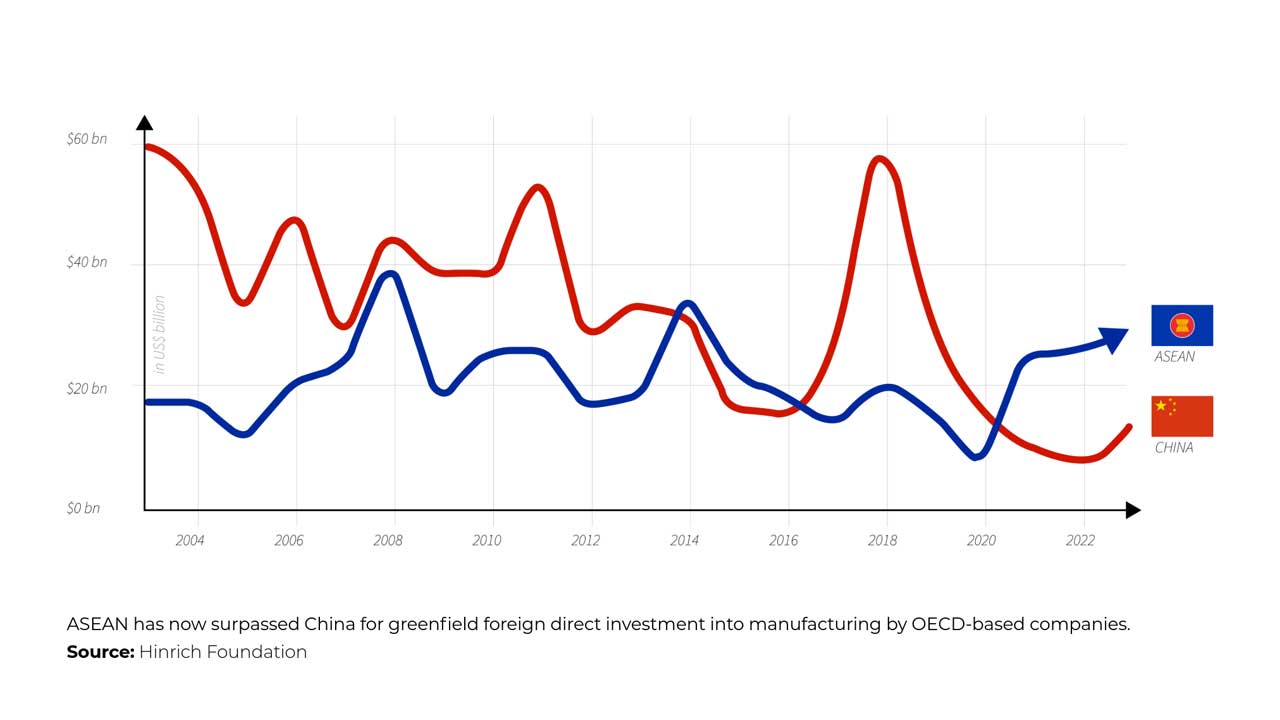
With its favourable demographic trends, competitive labour costs, and expanding infrastructure, the region has emerged as a prime beneficiary of this shift in strategy. Singapore, Vietnam, Thailand, Indonesia, and Malaysia have all seen significant inflows of foreign direct investment (FDI) as manufacturers look for alternatives in close proximity to their existing operations and systems in China. Singapore and Vietnam, for example, both saw accelerated growth in Q3 2024, according to McKinsey.
However, this re-orientation is not without complications, according to Stephen Olson at the ISEAS-Yusof Ishak Institute. While the region benefits from China’s slowing economic growth and the cost advantages of relocating manufacturing, Olson warns that it is also positioned precariously ahead of the modern day’s most significant “arm wrestling match” between the world’s largest economic powers: the U.S. and China.
Olson explains that higher tariff and non-tariff barriers will dampen export opportunities, adding that the second Trump administration will have no inclination to moderate any damaging trade policies deemed to be “unfair” or in violation of World Trade Organization (WTO) rules.
With the expected return of U.S. protectionism under Donald Trump, Southeast Asia faces a pressing question: will the “China Plus One” strategy benefit the region, or could it ultimately cost Southeast Asia by dragging it deeper into the geopolitical crossfire, with unpredictable consequences?
Washington’s Protectionist Shift
The Trump Administration’s “America First” protectionism is all but set to return, and Washington could pursue even more aggressive trade policies, potentially incentivising companies to accelerate the shift of their supply chains away from China. While this could benefit Southeast Asia in the short term, the region’s reliance on Chinese trade and investment creates a complex dilemma.
There is no consensus within ASEAN on the desirability of Chinese predominance in the region
On the one hand, Southeast Asia stands to benefit from increased American pressure on China. Companies doing business in the U.S. looking to reduce their exposure to China could redirect investment into the region, fuelling industrial growth and enhancing trade ties.
On the other hand, the Trump administration’s protectionist stance may cast the net of trade restrictions, tariffs, and quotas wider, potentially limiting Southeast Asia’s access to the U.S. market. Countries that heavily depend on U.S. exports, including Vietnam, Malaysia, and Thailand, might find themselves in a bind.
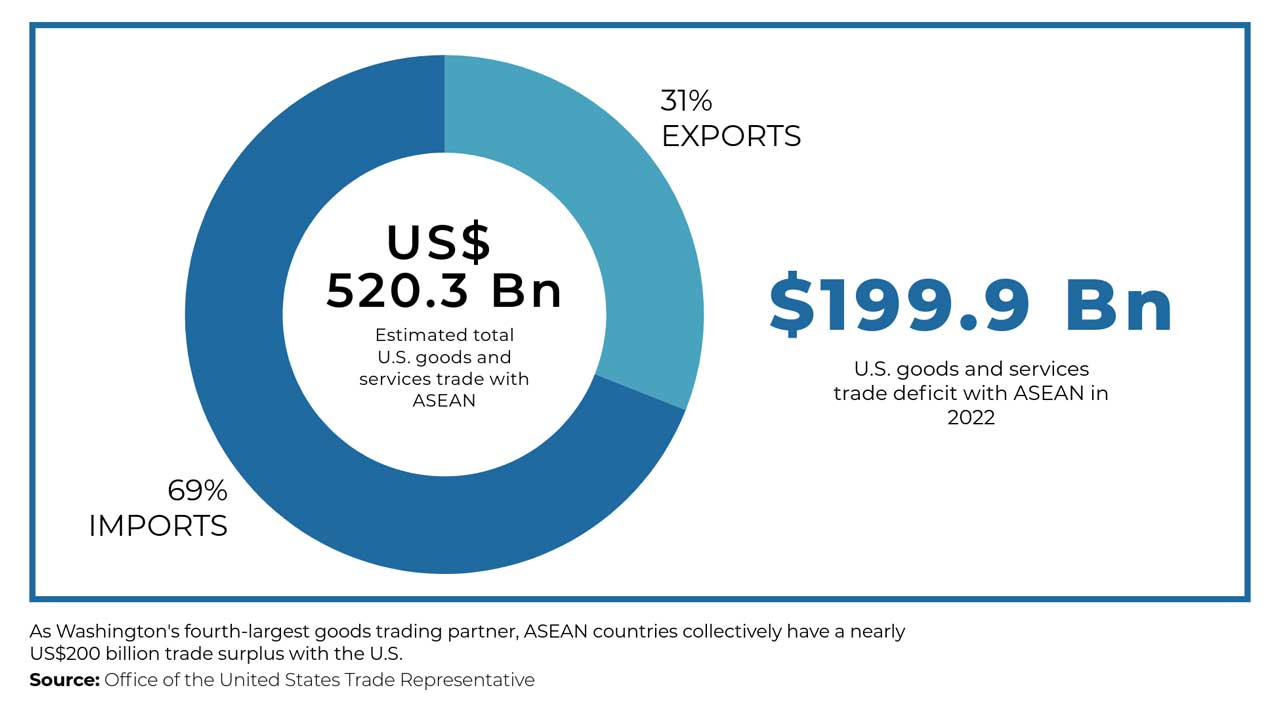
While conventional wisdom states that “China Plus One” brings more investment to the region, challenges including political instability, inadequate infrastructure in the ASEAN bloc, lack of transparency, and rising labour costs could severely hamstring the region.
Moreover, the long-term sustainability of the “China Plus One” model is uncertain. A reliance on foreign direct investment and multinational corporations means the region remains highly dependent on external factors, especially the domestic and foreign policies of Beijing and Washington. If the Trump administration pursues a more isolationist approach to trade or engages in a prolonged economic war with China, can Southeast Asia come out unscathed in the economic fallout from these two global giants?
According to Tomotaka Shoji of the Sasakawa Peace Foundation, navigating U.S.-China tensions will require Southeast Asian countries to also preserve ties with other partners. “There is no consensus within ASEAN on the desirability of Chinese predominance in the region… ASEAN will seek to maintain good relations with Washington. For this, too, ties with other major countries, including Japan, will play an ever-bigger role,” he said.
A Regional Dilemma
The overarching question for Southeast Asia in 2025 is whether the “China Plus One” strategy can herald a new era of economic growth, or if it will merely be a temporary solution that exacerbates the region’s vulnerability to external shocks.
ASEAN might adopt a direct ‘business-to-business’ approach to attract US investment while exploring new FDI sources
According to Lili Yan Ing and Yessi Vadila of the Economic Research Institute for ASEAN and East Asia, Southeast Asia could face reduced demand for its supplying inputs and intermediate goods for broader production networks in textiles, semiconductors, telecommunications, electrical equipment, machinery, computers, and automotive industries.
“To mitigate these risks, [the region] could focus on diversifying its economic partnerships, strengthening local manufacturing, and expanding trade ties with other major economies to reduce dependency on any single market. Additionally, ASEAN might adopt a direct ‘business-to-business’ approach to attract US investment while exploring new FDI sources.”
Will Southeast Asia succeed in diversifying its supply chains and reducing its dependence on China, or will it fall prey to the geopolitical realities of a new, protectionist world order under Trump?
As Southeast Asia grapples with these competing forces, the future of its economies — and the broader global supply chain — remains uncertain. The “China Plus One” strategy presents both promise and peril, and in a world marked by rising nationalism and shifting power dynamics, Southeast Asia must tread carefully, aware that the choices it makes today could shape its economic future for decades to come.
This is definitely a developing one to watch in the next few months.